

Puuc Route
Yucatán
The Puuc Route is one of the most important cultural routes in southern Yucatán and offers the opportunity to discover ancient Maya cities, monumental architecture, caves, and other places connected to the region’s heritage.
Its name refers to the Puuc region, a territory of low hills where ancient Maya communities developed a distinctive architectural style and different ways of making use of water, the landscape, and natural resources.
Although it is often identified primarily with a tour of some of the region’s most representative archaeological sites, the Puuc Route can be understood more broadly, incorporating other archaeological sites, museums, caves, and natural areas throughout the region.
Map of the Puuc Route

On this map, you can see where the main archaeological sites and other places of interest in the Puuc region are located, as well as their location in relation to the area’s main towns.
What is the Puuc Route?
The Puuc Route is a cultural and tourism circuit that brings together different places of interest in the Puuc region, in southern Yucatán.
Its main attraction is the Maya architecture developed in this area, recognizable for its facades decorated with stone mosaics, masks, and other ornamental elements. The ancient roads or sacbeob, monumental structures, and the way these cities adapted to a territory without large sources of surface water are also notable.
For this reason, exploring the Puuc Route is not simply about visiting several archaeological sites. It also provides an opportunity to understand the relationship between ancient Maya cities, caves, the landscape, and the natural resources of this region.
Puuc architecture
Puuc architecture reached one of its greatest developments in southern Yucatán and is characterized by detailed stonework.
Its buildings feature mosaic-style facades, decorated friezes, masks associated with Chaac, the Maya god of rain, and other elements that give these structures an appearance distinct from those found in other Maya regions.

Uxmal is one of the best-known examples, but Puuc architecture can also be seen at other sites throughout the region.

Puuc architecture can also be found outside the traditional tourist circuit and extends to other areas of Yucatán and Campeche, so the Puuc region is broader than the Puuc Route.
Which sites are part of the Puuc Route?
The traditional route consists of 5 of the region’s best-known sites:

Uxmal
One of the great Maya urban centers of the Puuc region and one of the most representative sites of its architecture.

Kabah
Known for its large buildings and the extraordinary decoration of its facades. It is also home to the Puuc Archaeological Museum, dedicated to the heritage of this region.

Sayil
It was one of the great cities of the Puuc region and preserves an extensive group of structures distributed throughout the vegetation.

Xlapak
A smaller site, but one that preserves interesting examples of Puuc architecture, particularly its buildings decorated with Chaac masks.

Labná
It is known for three of its main structures: the Arch, the Palace, and El Mirador.
These sites make up the classic route commonly associated with the Puuc Route and offer an opportunity to discover different expressions of the architecture and development of ancient Maya cities.
Would you prefer to explore the Puuc Route with a tour?
If you want to explore the Puuc Route without having to organize the transportation, schedules, and itinerary yourself.
Other archaeological sites along the Puuc Route
The Puuc Route does not end with the five sites on the traditional itinerary. The region preserves other settlements that help us understand the diversity and extent of this territory.

Oxkintok
One of the most important ancient Maya cities in the region, known for its large architectural complexes, anthropomorphic columns, stelae, and the famous Satunsat, or Labyrinth.

Chacmultún
It stands out for its buildings constructed on natural elevations, the reddish color of the stone, and the decorative details of its facades.

Loltún Caves
They showcase a different aspect of the region’s heritage. In addition to their large galleries and natural formations, evidence of human occupation and rock art have been found inside the caves.

Puuc Archaeological Museum
Located in Kabah, it complements visits to the archaeological sites in the region with artifacts and information related to Puuc archaeological heritage.
Caves and other places of interest in the Puuc region
The Puuc region can also be explored beyond its archaeological sites.
The caves are an important part of this territory’s landscape and offer another way to understand the relationship ancient communities had with the underground, water, and natural spaces.
Among the places you can include in your itinerary are:

Calcehtok Caves
Archaeological evidence and rock art have been found inside the caves, along with large underground spaces.

Aktún Usil Caves
Inside the cave, engravings and other forms of rock art have been preserved, along with archaeological remains and large underground spaces.
Why are caves part of the Puuc Route?
The caves help us understand that the heritage of the Puuc region is not limited to its ancient cities and buildings.
In a territory where surface water was scarce, caves and other underground spaces had an important relationship with the landscape and ancient communities.
For this reason, places such as Loltún, Calcehtok and Aktún Usil offer another way to discover the region: its natural spaces, archaeological evidence, and rock art.
Not all of these places are part of the traditional Puuc Route, but they can be incorporated into a broader tour of the Puuc region and complement visits to its main archaeological sites.
The Puuc Route beyond Yucatán
Puuc architecture is not limited to the Puuc Route tourist circuit or to the state of Yucatán.
There are also sites in Campeche where characteristics of this architectural tradition can be observed:

Xcalumkín
Known for its stone architecture and the numerous hieroglyphic inscriptions it preserves. Its buildings display characteristics of this architectural style.

Chunhuhub
The site stands out for the detailed stonework of its buildings, columns, and decorative elements, which show the development of this style in the region.
This allows us to distinguish between two concepts:
Puuc Route: the cultural and tourism circuit associated primarily with the sites of the Puuc region of Yucatán.
Puuc architecture: an architectural tradition that developed across a broader region and is also represented in other parts of the peninsula.
What is the traditional Puuc Route itinerary?
The traditional route usually starts in the Uxmal area and heads south, following the road known as the Puuc Route.
One of the best-known sequences is:
Uxmal → Kabah → Sayil → Xlapak → Labná

From this route, you can expand your visit to other places in the region, such as Oxkintok, Chacmultún, Loltún, Calcehtok and Aktún Usil, depending on the time available and access conditions at each location.
The route itself can be explored in different ways, so there is no need to try to visit all the sites in a single day.
Would you prefer to explore the Puuc Route with a tour?
If you want to explore the Puuc Route without having to organize the transportation, schedules, and itinerary yourself, you can also do so through a tour from Mérida.
How to get to the Puuc Route by Tren Maya?
The Tren Maya allows you to get closer to different points from which you can continue by road toward the Puuc region.
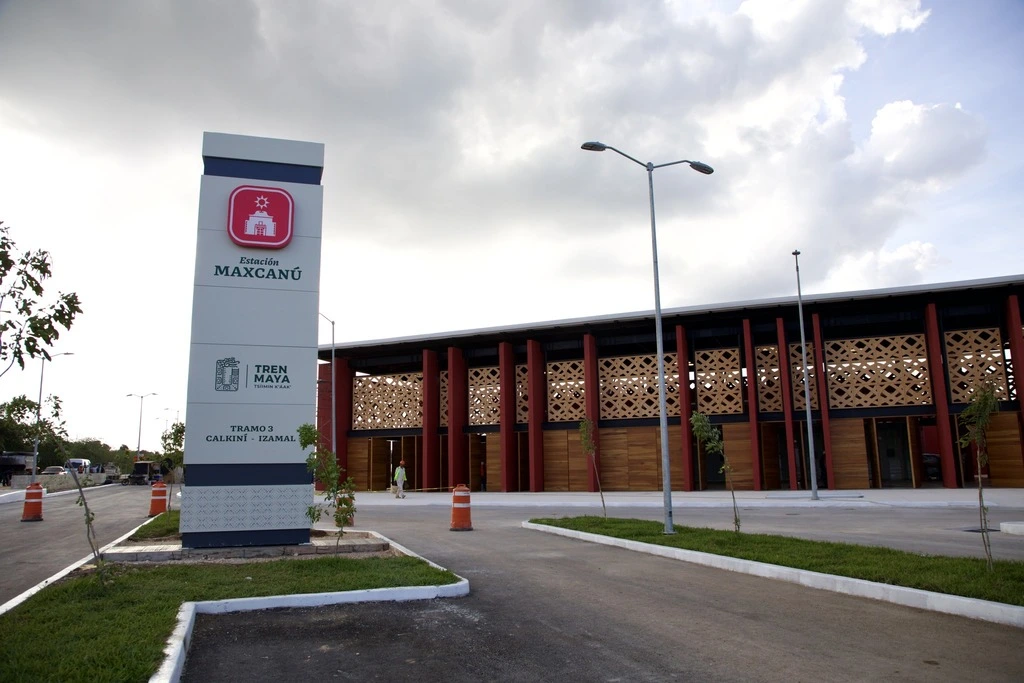
Maxcanú Station is especially useful for visiting Oxkintok, Aktún Usil Caves and other nearby places in this area.

Calkiní Station, in Campeche, can also be used as an arrival point for exploring the Puuc region.
How much time do you need to explore the Puuc Route?
There is no single amount of time needed to explore the Puuc Route, as it depends on the places you want to visit and how much time you want to spend at each one.
If you only want to visit the traditional five-site route — Uxmal, Kabah, Sayil, Xlapak, and Labná —, you can do it in one day, organizing your transfers and visiting hours.
If you want to expand your itinerary to visit Oxkintok, caves, or other places in the region, it is recommended to allow at least two days. The distances are greater, and you will need to consider travel time, the opening hours of each place, and how much time you want to spend at each site.
If you have more days available, you can explore the region at a more relaxed pace and combine different archaeological sites with caves, museums, communities, and other places of interest.
How much does it cost to visit the Puuc Route?
The Puuc Route does not have a single admission fee, as it is an itinerary that brings together different archaeological sites, caves, museums, and other places of interest, each with its own fees and access conditions.
If you explore the route on your own, the main cost will depend on the admission fees for the sites you choose to visit, in addition to transportation and any other expenses you may have during your trip.
| Archaeological site | Mexican nationals | Foreign visitors |
|---|---|---|
| Uxmal | $262.00 MXN | $566.00 MXN |
| Kabah | $85.00 MXN | $155.00 MXN |
| Sayil | $80.00 MXN | $145.00 MXN |
| Xlapak | $80.00 MXN | $145.00 MXN |
| Labná | $80.00 MXN | $145.00 MXN |
| Oxkintok | $80.00 MXN | $145.00 MXN |
| Chacmultún | $80.00 MXN | $145.00 MXN |
Traditional Puuc Route (5 sites) — 2026 prices
- Mexican nationals: $587.00 MXN
- Foreign visitors: $1,156.00 MXN
There are also Puuc Route tours, whose price may include transportation, admission fees, a guide, and other services, depending on what each tour includes.
What can you see on the Puuc Route?
In addition to the great Maya cities, the region offers the opportunity to combine different types of experiences:
- Archaeological sites
- Puuc architecture
- Caves and caverns
- Museums
- Landscapes of the Puuc region
- Ancient roads and sacbeob
- Sculpture and architectural decoration
- Engravings and rock art
- Communities and towns in the region
This variety allows the itinerary to be adapted both to those who want to visit the main Maya cities and to those who want to explore other aspects of the region’s heritage.
Discover the Puuc Route
The Puuc Route is much more than a road connecting archaeological sites. It is a region where you can find ancient Maya cities, monumental architecture, caves, rock art, museums, and landscapes that help explain how ancient communities adapted to this territory.
You can organize the itinerary on your own, choose the places that interest you most, and check their current visiting conditions. You can also explore the Puuc Route through a tour, a practical option if you prefer to have the itinerary and transportation organized for you.